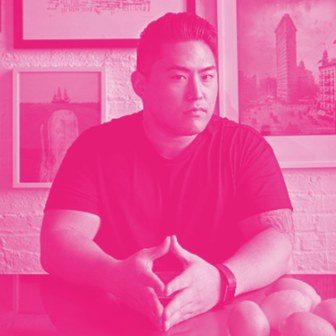
An interview with Paul Jun
Form follows fantasy
Creative Director, Brand at Ramp
July 2026
Paul Jun leads brand design at Ramp, where his team shapes the identity and builds the systems that help it scale. After seventeen years in the industry, he believes AI gives brand teams a chance to reimagine how they work and the impact they make.
Paul has crossed the line from designer to designer-builder. After opening Cursor in late 2023, he built a Figma plugin in three days. At Ramp, he is prototyping brand tools and review systems, and creating shared skill libraries that carry the same brand strategy, voice, and standards.
The conversation moves through why brand and product were split apart, how brand becomes executable without becoming generic, and why Paul thinks small teams of artists and builders can take an idea from story to software. He calls this the dial-up era of AI.
What changes when brand reports into product and engineering versus when it reports into marketing? And what does that look like at Ramp today?
The reporting line changes the team’s default question. Under marketing, it tends to be, “How do we promote this?” Closer to product and engineering, it becomes, “What experience are we building?” A great company has to answer both.
In my experience, startups often put brand under marketing for understandable reasons. Marketing owned distribution, budget, and measurable growth. Product design sat beside engineering because it helped make the thing. Many modern tech companies inherited that structure and rarely revisited it. It isn’t a villain story. It’s a default that hardened into doctrine.
Brand and product design are two halves of the same discipline. Both shape behavior, perception, and experience. I joke that product design is form follows function and brand design is form follows fantasy. The real opportunity is when function and fantasy share a room.
At Ramp, brand works across the company. We partner with marketing and growth every day, and with product, engineering, sales, and research. Marketing is how the promise travels. Product is where the promise gets kept. The question is less who owns brand than whether the brand has the access and authority to shape the whole experience.
AI can absorb recurring production that brand designers typically do. That gives the brand team more time for the product, the story, and what comes next. The goal is not a new reporting line. It is one coherent customer experience, the systems that allow everyone, every team, to make the brand easy to love.
You mentioned startups move through phases. Can you walk through those?
I think of startups as playing three different games as they grow.
The first is finding a useful function and earning product-market fit. You are proving that the product solves a real problem. Brand gives that early product a clear promise and a reason to be trusted.
The second is the feature race. One company ships something, and the next says, “We have it too, only better.” Companies can stay here for years, copying one another’s roadmaps in a race with no finish line. The feature you shipped this morning has the shelf life of a banana.
The third is experience. The question moves from what the product does to how it feels, what it believes, and why someone would choose it again. Rosetta Stone is a utility. Duolingo is an experience. People remember the second one.
Brand matters in all three; its job changes. Early, it earns attention and trust. In the feature race, it keeps the roadmap from becoming purely reactive. At parity, the durable advantages are brand, craft, technical depth, and imagination. Features explain the product. Experience makes it memorable.
You said most product designers don’t think this way, that they’re too narrow, and that only a handful can do both. Why is that, and how do people upskill into being an all-encompassing brand and product designer?
I would put it differently: the people are not narrow. The jobs trained them to be narrow. Economics influences org charts more than anything.
Product designers became fluent in systems, interaction, accessibility, and utility. Brand designers kept working in symbols, stories, typography, culture, and feeling. They are twins separated by an org chart. The most interesting designers can move between both: how a thing works and how it feels. These designers are insanely rare, but I think with AI, we will see a new kind of designer forming over the next decade.
You do not need to master every craft. You can’t, you don’t have enough time. You need enough range to carry an idea without losing the thread. If you work in product, study brand design, writing, and cultural history. If you work in brand, study product development, sales, and code. Both should write. Both should ship. Both should study work outside software.
AI helps you cross that boundary, but it does not let you skip the fundamentals. Use it to attempt a bigger project, not to avoid the apprenticeship. Own one thing from story to pixels to code. That is how range is built. And besides, if you love learning, using these new tools to build things that we couldn’t have before has been equally exhausting and exhilarating. In all the best ways possible.
At Ramp, all designers build and improve upon systems that enable others to bring their ideas to life. From web pages made directly from the terminal or our internal tool, Glass, to making prototypes with our design systems… it’s an incredible moment to be a designer. The brand team is working on things that will enable others to do brand design well — the same way the design systems team creates tools for any designer to create product prototypes — to imbue that new skill into how they think and make. I think that’s at the heart of what it means to be a builder: a learner.
Where do you think the divide between brand and product actually came from?
In 1941, Bill Bernbach, a copywriter, met Paul Rand, an art director and designer, at the Weintraub agency in Manhattan. Copywriters and art directors usually worked on different floors. Rand and Bernbach began solving the whole idea together. That partnership helped create the modern creative team. Bernbach went to start DDB and created works that we still study and revere today.
Tech and the ZIRP economics separated the teams and the work again. As software grew, product design moved beside engineering; brand moved beside marketing. Specialization solved a real problem. Then the largest tech companies made that structure look inevitable. In my view, startups copied the org charts, and an arrangement became a belief about what each discipline was allowed to do.
AI changes everything we assumed to be true and tested. A brand designer can prototype a working product or build tools to completely automate marketing assets like business reports or whitepapers. A product designer can shape the narrative and expression using the team’s skills. A copywriter can build a prototype. An engineer can contribute to the brand system. Small teams can own an outcome end to end with fewer handoffs. That’s the future.
We’ve been arguing that brand comes from the founding team’s vision and is the product made visible, that it’s an extension of both product and team. Do you agree, or push back?
I agree, with one addition: the extension is behavior, not resemblance.
The founders write the first lines. The product makes the belief tangible. The team keeps proving it through thousands of decisions: what gets built, what gets ignored, how sales talks, how support responds, and what happens when something goes wrong. A brand has to answer two questions: What do you believe? How will you behave?
Ramp is a good example. The team before me built an identity that feels quiet and confident in a category that can be intimidating and noisy. I take no credit for that. The engineering makes the same promise in another form. The product is fast and automatic. The promise is to save you time and money. It’s been incredibly consistent. Now we’re building a future world of Ramp, and that’s about creating coherence with this promise.
Marketing might get you known. Product earns trust. Brand is how people fall in love.
At scale, every company desires the work to perform like a symphony. Eighty musicians can play different notes and still create one piece because they share a score. Brand strategy is the score. The systems help product, marketing, sales, and support make music together that enters culture, and in turn, changes culture. That’s how brands win.
The goal is coherence, not rigid consistency. Consistency says, “We always look like this.” Coherence says, “We evolve, and you still know it is us.”
That symphony point is fun, because no company really pulls it off. People point to Apple, where everything is coordinated. But does that hold up?
Apple holds up because the point of view survives on every surface: the product, the packaging, the store, the setup, the support, the launch. The lesson is not that every pixel must match. The lesson is that every decision should keep the same promise.
AI can help more companies carry the score by remembering the rules and catching drift. It cannot choose the promise or write the music. That still takes judgment and expertise and care.
Every org I’ve worked at that was scaling up struggles with coherence and collaboration. There are many companies right now that will go from 50 to 100 people within a year. How do you create systems that allow everyone to sing from the same songsheet? To buy into the mission and vision, and to feel deeply accountable for the outcomes that turn vision into reality? That is leadership. That is systems. And the future of AI brand systems can enable this.
We’ve been writing about brand becoming programmable: recurring work handled by systems while creative judgment stays in the loop. What does that mean in practice, and how are you thinking about it at Ramp?
For as long as I can remember, brand designers have been spoken to like LLMs.
A request went into a box. Someone waited. The designer returned the output. White paper. Deck. Ad. Landing page. Chart. Social post. Then came the next prompt.
AI did not create that pressure. It turned up the volume.
I’ve watched in-house brand teams wrestle with the same tensions for more than fifteen years. Small team. Giant surface area. Speed against craft. Static guidelines. Murky decision rights. A service-desk reputation. Too often, a company asks the team to shape perception, then fills the team’s calendar with tickets. That is an org-design problem, not a talent problem.
At Ramp, we’re asking: how much of the ingredients of a brand system — typography, color, grid systems, icons, illustrations, motion, voice, photography, animation, layout, etc. — can be code?
Because most of it is code, then the assets all other teams need — decks of every variety, one-pagers, documents, product graphics, performance ads, etc. etc. etc. — can be programmable. It can be delivered at the speed of thought. Imagine you’re a sales person, you have a call in an hour. The brand system looks at your Gong calls, your latest Notion documents, it understands the brand strategy, and it creates you a specialized, specific deck for that customer. Personalized and 100% on-brand. Product, growth, sales, and go-to-market all need graphics, photography, landing pages, decks, reports, documents, and charts. AI will multiply that volume. Without the right systems, people route around brand and make the work themselves.
The output will often look plausible. The typeface is right. The image is close enough. The chart is cleaner than before. Plausible is not the same as good. Close enough is how a brand starts to drift.
My vision for Ramp is simple: make the brand easy to love and impossible to misuse. The second half is where the DNA of a brand designer is changing.
Brand as an operating system governs decisions. Brand as software makes those decisions repeatable and scalable.
Making brand programmable means automating repeatable artifacts without automating the point of view or creativity. A deck or report or a landing page is assembled from copy, imagery, type, layout, customer proof, etc.. We begin with dozens of 10/10 examples, translate the decisions behind them into code, and test where the system holds or breaks.
We’re exploring how far this can go and where the front door belongs: Slack, Glass, or another interface. We are still testing those paths. Beneath the interface, the system needs approved material, product truth, and permission to stop when context is missing.
I do not know how much of this the models can do today. I suspect we underestimate what they will do next. That is why I want to build the sandbox now. I want to anticipate the models getting so powerful that they will continue to shock us. I don’t want to be blind-sided. I want to be at the front of the rollercoaster knowing what’s bending around the corner, and Ramp is a unique place to experience that every single day.
These tools are products. They need an owner, engineering time, maintenance, customer relationships, and a roadmap. Calling the work “tooling” does not make it free or easy.
The old answer was governance. PDFs. Brand portals. Guidelines. Templates. A polite little graveyard of good intentions. Those artifacts still have value. They are passive. The new answer lives where the work happens and gets better as we learn where it breaks.
A static guideline tells you what the brand was. A programmable system helps make what comes next.
You describe the future brand team as artists and builders. How do those roles work together?
Artists make the original language. Builders make that language scale.
Artists make the brand easy to love. Builders make it impossible to misuse.
Artists define the point of view and show us what should exist. They stretch the language and break rules intelligently. Builders translate those decisions into components, tools, agents, workflows, and evaluations. Editors and creative directors close the loop by curating examples, critiquing output, and deciding what enters the system.
It is a loop, not a hierarchy. Artists raise the ceiling. Builders raise the floor. Sometimes one person can do both, and that combination is powerful. Forcing every great artist to code would waste talent. Building a system without artists would encode mediocrity.
My longer-term bet is that a team of fewer than ten people can take an idea from zero to one. The mix might include engineering, PMM, sales, brand design, writing, or video, depending on the work. Clear remits protect focus. A shared direction keeps the pod connected. A compelling story is the compass that drives direction.
Brand design gets its moment when it stops being the production layer at the end and starts creating the language and machinery that enable others to represent the brand well.
The artist makes the thing worth scaling. The builder helps it survive scale. The work can travel farther without losing its voice.
If the system absorbs more repeatable work, what should brand designers do with the capacity that comes back?
A problem arrives with a ticket. An opportunity appears because you were paying attention.
Brand teams need both. Problem solving protects today. Opportunity seeking creates tomorrow.
Problem-solving asks, What’s wrong?” Opportunity-seeking asks, “What if?”
Problem solving matters. The mistake is solving the same problem by hand forever. A repeated request is a signal. Sometimes the answer is infrastructure and better systems.
Fifty comments in a Google Slide cost more than an afternoon. They cost the customer conversation, the next product story, the new visual language, and the system that prevents the next hundred comments.
Capacity does not protect itself. If automation only raises the output quota, we learned nothing. A leader has to reserve that time for the work that thinks about new tomorrows.
Some teams will use AI to make more stuff. Faster decks. Faster ads. Faster landing pages. Faster slop.
I want to use it to make more room. Room to think. Room to argue. Room to sit with an idea long enough for it to become something. Room for artists to make the original thing by hand, then work with builders to turn it into a system without watering it down.
Brand designers will still make the work. Their value will be measured by what they make possible, not by the number of tickets they close.
The machine can produce more. The company should imagine and think and build more.
Is this a good moment for creatives?
Yes. I think it is an extraordinary moment for creatives. I’ve never had more fun. It’s like a video game finally getting a patch that everyone has been waiting for. I love what AI is allowing me to do. My sense of possibility has expanded so much that none of this feels like work. It feels like play.
Eric Hoffer wrote, “In times of change, learners inherit the earth, while the learned find themselves beautifully equipped to deal with a world that no longer exists.” That is the posture: remain a learner.
AI shortens the distance between an idea and an outcome. In late 2023, I opened Cursor and built a Figma plugin in three days. Then I kept going. I built an image editing tool. Then I challenged myself to build a full-stack product so I can learn about databases and backend systems. I researched, branded, designed, wrote, and built The Tenth Muse, a full-stack product with more than 150,000 artworks from over 20 institutions. I could not have attempted that alone a few years earlier.
The tools raise the floor. That makes point of view, craft, judgment, and character more valuable. Taste is not a shortcut. It is the residue of what you study, practice, and choose over time.
Use AI to cross a boundary, not to skip the fundamentals. Study the masters and the newest models. Write without assistance sometimes. Build with assistance often. Ask hard questions about the technology, then learn enough to form your own view. Curiosity is part of the job.
We are still in the dial-up phase. The future does not belong to the person who knows one tool best. It belongs to the person who keeps learning without forgetting what good feels like.
Rapid fire
Late 2023. I had a week off, opened Cursor, and promised myself I would push through the frustration. Three days later, I had a working Figma plugin that should have been beyond me. I sent it to an engineer, and he called to ask when I had learned to code. I hadn’t. The distance between imagination and execution had changed.
Make the brand easy to love and impossible to misuse. And that’s on us.