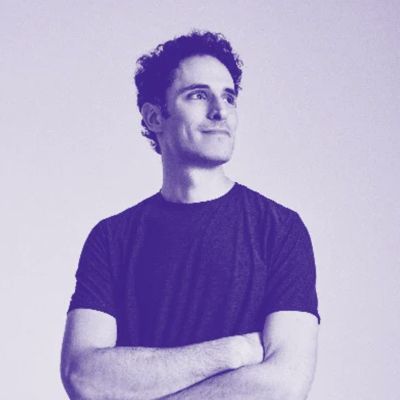
An interview with Nir Zicherman, co-founder and CEO of Oboe
Building the generalized learning platform
June 2026
Nir Zicherman taught himself to program in law school, co-founded Anchor in 2015, and sold it to Spotify in 2019, where he spent nearly five years building the audiobooks business he still uses every day. Now he’s building Oboe, a consumer learning platform built on a conviction he carried for years, that billions of people already use the internet to learn and yet none of the tools they reach for were built to teach them. We wanted to talk to Nir because Oboe is one of the rare AI products going broad and globally ambitious rather than narrow, and because he believes great product matters more as building software gets easier. We dug into why it’s important to understand users’ intrinsic vs extrinsic motivations, why he’d rather build something billions of people use than something easy to pinpoint, and how he thinks of Oboe as a long-term, ambitious bet.
What is your background and how does that feed into building consumer platforms in audio and now learning. If I recall correctly, you were also in law?
I was in law, but I never practiced. I went to law school and fell in love with programming while I was there, and decided I wanted to do that instead. That’s how I got into the New York tech scene. I graduated law school in 2011. It’s interesting, everything I use professionally is something I taught myself, and nothing I formally learned is in any way relevant to what I do. I majored in poli sci, went to law school, and clearly I don’t do things related to either.
And then Anchor came a few years later?
A few years later I worked with Mike Mignano, who’s now a partner at USV. He and I worked together at a startup that got acquired by Adobe, so we went through that acquisition together, and then we quit our jobs to start Anchor. This was 2015. The idea was that podcasting seemed to be taking off, and everyone was talking about increasing demand for the medium. Connected cars were getting built for the first time. That was the year the Alexa came out. There was more investment in distribution and a realization that demand for podcasting was going to go up. And yet it was really, really hard to create podcasts. So the whole thesis was, can we be the catalyst that makes the supply side of the industry grow to match the demand side? We timed it very well. We entered the market at the exact moment podcasting became a thing anybody cared about. Prior to 2014 / 2015, nobody had heard of podcasts, and then all of a sudden everybody on planet Earth wanted to make one.
Do you remember the first podcast you listened to as a consumer?
I don’t remember the first one, but the one that completely changed the game was Serial. Before Serial, podcasting wasn’t mainstream media. Then all of a sudden people started talking about every episode as it was dropping, theories, all of it. The last time people had talked about anything like that was when Lost was on TV!
You grew Anchor and sold it to Spotify in 2019. What did you do at Spotify?
I was at Spotify for almost five years, and most of my time there was spent building the audiobooks business. My selfish reason for driving that initiative through was that I really wanted to use it as a consumer, and I still do every single day. I loved working on that. But eventually it was kind of: mission accomplished. I got to ship the thing I really wanted to ship.
What was the itch that drove you to found Oboe?
I’m a very enthusiastic lifelong learner of many things. I taught myself how to program in law school. For a long time I’ve had this belief — every single day there are billions of people who use the internet to learn. They use Wikipedia, YouTube, now ChatGPT and other LLMs. They stitch together all of these resources that exist online to put a learning path together for themselves, to teach themselves whatever it is they want to learn. And when I say learn, I don’t just mean formal education, I mean truly anything. You probably do this ten times a day when you go to the internet to understand something new. The strange thing is that despite billions of people doing this every day, not one of the platforms they regularly use was built to teach. You’re retrofitting all of these technologies into your desire to learn. It always struck me as strange that there’s no truly generalized learning platform on the internet.
The products that have actually been built to teach suffer from two problems. The first is they’re very prescriptive about how they teach you. They tend to be linear, with the assumption that anyone coming in to learn calculus or programming should be on the same A, B, C, D journey to some outcome Z. The second is that they’re overly focused on very specific domains. When I say “generalized learning platform”, I mean one that is simultaneously personalized and broad enough to encompass anything you exhibit that online learning behavior for every single day.
Prior to AI, it wasn’t technically feasible or cost effective to build what I just described. The realization I had around 2023 was that the technology is now at a point where this vision can finally be built. You can build a product that’s adaptable to the user, completely personalized to what they want to learn and how they want to learn, with multiple formats and modalities. Can you deliver a 10x better experience than the random piecemeal one people get by stitching together other resources? Once I realized it was finally feasible, I knew if I didn’t build this, somebody else would.
Consumers spend so much time today getting information pushed at them on YouTube and social platforms. The business models there, ads / time spent, might not lead to what you’re describing, which is the end user actually learning effectively. How do you think about that?
The way I’ve always thought about it is that there are extrinsic and intrinsic motivations to learn. An extrinsic motivation is an expectation placed on you from someone else. Intrinsic means it comes from your own internal desires, your own passion, your own interest. If you think about the things you’ve successfully learned as an adult, out of school, on the job, or as a hobby, I’m willing to bet 99% of what stuck came from intrinsic motivation. One of the challenges is the assumption that learning has to be an expectation placed on you by some outside force, and then it’s your job to adapt and retain it. That’s why most people don’t enjoy learning in adulthood. And yet those billions of people online clearly have things they’re intrinsically motivated to learn, because they keep going down rabbit holes. They just don’t have the tools to tap into that motivation. A big part of what we talk about is whether you can build a learning platform that lets people tap into whatever intrinsically motivates them, so they willingly want to come and spend time on it.
So a big goal of the platform is getting the end user to want to learn from their own motivation.
That’s right. One of the things we often think about is what I call high intent, high curiosity. When it comes to user acquisition, it’s often some extrinsic force causing the user to want an answer to a particular question or to create a course, just like when you go to YouTube and search for a video. Something externally triggered you, and you have high intent to consume that one video. But the reason you stick around and heavily engage is because you’re generally curious about a lot of different things. User acquisition is very different from continual engagement. Someone might come to Oboe to answer a particular question or because they have a specific need. The reason they should stick around is that they’re willing to go down rabbit holes and side quests on things that are intrinsically motivating. You have to have a generalized platform to do that. If YouTube only served you videos about the one vertical you came in for, you wouldn’t stick around. Humans are interested in many, many different things.
What is your product philosophy behind Oboe? And how does the flow through to the branding, like the little rabbit that jumps, and the multimodal outputs that get created?
First, we intentionally do not call this an education product, because that term is very limiting. The ambitious, grand-slam vision is to build a consumer product that billions of people use every day, because I believe people already exhibit this behavior and we can capture that demand. There may be opportunities to do non-consumer things in the future, but that’s secondary. Step one is to build a massive online consumer platform.
To achieve that, you need to get over the stigma people associate with education, of it being overwhelming, information-heavy, daunting, and not accessible. The design and the positioning of the product are critical. You need to strike a balance of authority and playfulness at the same time. It needs to be something people trust. One of the things we repeatedly hear from users is that they trust us, because the content feels high quality, accurate, and backed by reliable sources, while at the same time feeling very accessible. To appeal to consumers you have to do both.
What are the buckets that are hardest to solve right now? Is it technical, like memory management or generating multimodal outputs, or more on the product side of interface and branding, or something else?
From a product standpoint, one healthy tension we feel is that because there are many potential use cases, it’s hard to know which experiences to prioritize first. Depending on which type of user is coming in and why, it might make more sense to do A or B. Figuring out how to have a product that’s sufficiently welcoming of those different use cases has been tough, but really interesting. In the early days you want to let the market guide what you do, so you don’t want to close doors prematurely.
We don’t have one strong pull, we have multiple. Internally we have six core user segments. They’re not even a particular use case, more like personas for a type of user. They’re all healthily at odds with each other. It would have been both helpful and limiting if it were clear there was one very particular type of user. I actually think it’s validating for my long-term hypothesis around this being a global product with disparate interest, even though in the near term it makes the product harder to build. The personas are differentiated specifically by why they come to the product. For instance, one cohort is students, who come in for a very particular reason even though they use Oboe for a hundred different verticals. They’re motivated by the same underlying desire, which is very different from lifelong learners, who are driven by an entirely different set of motivations.
What do you think most people, investors or other builders, are getting wrong about consumer AI?
The assumption over the last couple of years, and I imagine most of the companies you two see fall into this category, is that there’s an interesting new underlying tech capability, so let’s apply it to a very specific use case that can benefit from it and capture that market. Don’t get me wrong, I think that’s interesting. It’s just not the business I’m interested in building. In a lot of ways founders over the last few years have been scared to take bets on truly long-term, ambitious products, the exception being foundational models, which have their own problems and have become a commodity. There really aren’t many products I can think of attempting to build something truly broad, generalized, and globally applicable for consumers.
Ten years ago that’s what every founder was focused on doing, and for some reason it’s been such a shift. I believe that’s a short-term shift in the market’s mentality. It’ll take a couple of very successful products for others to wake up to the fact that you can be extremely ambitious and think really long-term about the products you want to build.
We believe people thinking creatively, with taste, matter more now, because the tools are in everyone’s hands and building is democratized. So you stand out with a marginally better product, one that’s lovelier and more beautiful to use, and with the way you message it. Does that resonate with you, or would you push back?
I agree with that fully. People assume the importance of product goes down as access to building it becomes more democratized and commoditized. I feel the exact opposite, for the same reason I think AI’s ability to write a novel makes a human-written novel substantially more valuable. I know a lot of people would disagree, but when it becomes trivially easy to build software, it becomes trivially easy to stop thinking about product from a real user standpoint. Every person we hire is extremely product oriented, first and foremost, especially because now everybody on the team can be a developer and everybody commits code, even without a technical background. We very frequently talk about product. The two differentiators for a product like this that win long-term are an amazing product and amazing content. If you can do both, you’ll build something substantially better than everything else out there, including what the foundational models can do, because none of them are focused on doing that for our use case. If you build a product people love using, and you do it by generating content people love consuming because it actually solves their problem, that’s a winning strategy.
Rapid Fire
Both of my kids are learning instruments now, and that’s gotten me excited. I grew up playing, especially piano. Both my kids are learning piano, my son started taking drums, and my daughter plays saxophone. There’s a lot of music going on at any given time.
Listening to podcasts where people talk about company or product building, even if it’s completely unrelated to what I’m doing. A great example is Acquired, which I listen to all the time. I can listen to an episode about something that has nothing to do with anything I’ll ever work on, and it always gets my mind turning. My wife and I both listened to the Costco episode and immediately signed up for a Costco membership.
Spotify. It’s a little bit of a cheap answer since I worked there for years, but I admire it for two reasons. They single-handedly redefined the way billions of people interact with an industry that had been around forever. And as far as larger tech companies go, they’re fearless in their willingness to take on new things, adapt, and try stuff, which I saw firsthand.
Go to oboe.com and create a course about anything you want to learn. We’re hiring full-stack engineers, based in New York!