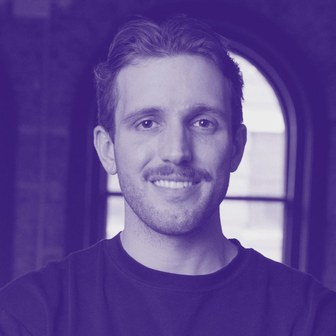
An interview with Dylan Babbs, Co-founder and CTO of Profound
Designing for trust in new categories
June 2026
Most of what Creative Conviction studies lives at the place where product, GTM, and brand stop being separate disciplines and start being one thing. Dylan Babbs is building a company that sits right in this theme. He is co-founder and CTO of Profound, which began as the SEO for AI search — the analytics layer that helps brands see what people are asking and how they show up inside answers from the models most people use. Built fast and at a high quality bar, it landed Target, Figma, Ramp, MongoDB, Plaid, Clay, Chime, Indeed, U.S. Bank, and Walmart. Now Profound is into what Dylan calls its second chapter. The bet is that the same way Cursor is to developers, Profound can be the AI native application layer where marketers do their work. Before Profound, Dylan was a design engineer at Uber, before that title was commonplace, and he has strong opinions about most of what follows. He thinks design oriented founding teams win on an advantage others can’t easily copy. He thinks a lot of brilliant people are pouring their lives into businesses with physical limits on how far they can go. And he thinks the interface of an AI is still a big problem not totally solved yet.
Tell us about Profound and where you think it fits in this future of being the infrastructure for brand and marketing.
We started off as the SEO for AI search company. We built this analytics layer to help brands see what people are searching for, what the outputs of their searches are, and how they’re actually showing up. The timing was good, and we also built it at a very high quality level really fast, which led to a lot of our success.
What we learned along the way is that once you know how you rank, the next thing you want is to make a change and take action, because you always want to improve and be at the top of your industry. The way to do that is all about writing the most effective content and shaping your digital presence to show up the best in ChatGPT. LLMs opened up our business in two ways. There’s the first order effect, this new consumer product where the answer is in ChatGPT, which is at nearly a billion monthly active users now. And there’s the second order effect, where LLMs are a piece of technology you can apply to our own industry.
So the main thesis of the second chapter is how do you help marketers work more efficiently and harness AI to do their work. We want to be synonymous with marketing the same way Cursor is for developers, Rogo and others are for finance. Profound will be that AI native application layer for marketers to go do their work.
We don’t normally like to comp ourselves directly to the SEO industry, but I’ll do it for this example. In 2024, $93 billion was spent on SEO. Out of that, only $3 billion was spent on analytics, the measurement tools like Semrush, BrightEdge, Ahrefs. The other $90 billion is the services industry, hiring an SEO agency or a digital marketing agency to research how to position your brand, write content, build your websites. So 3 to 90 is a 30x bigger market. We were the leading provider on the analytics side and got these enterprise deals with Target, Figma, Ramp, MongoDB, Plaid, Clay, Chime, Indeed, U.S. Bank, and Walmart, and a lot of additional Fortune 500. Now it comes down to whether we can build the product they want.
How do you define how Profound takes action, and what kinds of actions it takes for the marketer? Where are you leaning in first, and what are you not going to do?
We started off quite opinionated. It was, okay, we’re going to build these models that tell you the most effective strategies to follow. That shifted over time as our vision got broader, to where we almost want to be unopinionated and just give tools to marketers. The reason is that the strategies are always changing. You’re never going to know them perfectly or keep up to date, and the best strategies people are going to come up with themselves. We want to give them the creative liberties to find them and then execute on them with Profound.
So phase two, what we’re calling Profound Agents, is an agent builder. You have the deterministic workflows, like Zapier, and you also have the ability to have probabilistic agents that run on their own. What makes the difference for us is full integration with your Profound data. You actually know how well you’re ranking in certain topics, keywords, sites, and you feed those into the agents so they can run on their own. The third piece is really deep integrations into all your marketing tools. That’s where you start to differentiate.
Do you think of Profound as a creative tool?
Eventually, in about three years, we’re not going to be doing just text content. It’s going to go toward image and video generation as well. Right now what we have is the analytics, how your content’s performing, and the ability to generate content.
The next thing we’re building is a content management system, because then you have the ability to publish. Relying on third party systems is fine right now, but you almost want to own the means of distribution. Then you have the full stack, analytics, publishing, generation. And you might as well go on the other axis too. What types of content could you do? You move beyond text into images and video. We have very grand ambitions for Profound. Then there’s another axis, almost a three dimensional chart, where it’s product marketing, performance marketing, social media marketing, brand marketing.
When you own the question of what to push out, it’s so much easier to build the infrastructure for pushing it out, as opposed to the harder initial question of what do we even make. Such an interesting position to own the means of distribution.
Thank you. We’re excited about it as well.
Coming from the design engineering world, how have you been opinionated about the skills you look for, and how you’ve set up your design and product marketing org?
We can start general. For every function you have to be an expert in your field. If you’re going to be a software engineer, you have to be a good engineer. Beyond that we look for four soft qualities. One is you have to be an owner. Profound was really never much about management. You’re going to get your area, carve it out, and be the person in charge, setting your own roadmap and being responsible for what’s going on. That attracts a lot of good people, knowing they actually have an impact.
Number two is curiosity. We’re building things that have never been done before, so you can’t just repeat a playbook. You want to go learn and try and do things and be excited about what else is out there. Number three is being a really good person. One thing we’ve been strict on that’s worked out well is not hiring the 100x engineer who’s an asshole and destroys the culture. At the end of the day a company is just a group of people in a room, and you need to be excited to collaborate. I’m surprised at how many people come in and say it’s the most welcoming experience they’ve ever had. The fourth one is you have to work hard. We’re quite infamous for our Saturdays.
For design specifically there are three things I look for. One is visual skills, knowing how to make things look good, the taste aspect. The second is product design, knowing how to design for the business, not the user. That’s an important one most designers lack unless they’ve worked at a Meta or Uber where they drill it into you. The third is the design engineering side. We’ve been strict that if you’re going to be a designer at Profound you have to have two out of three of those. In the beginning I wanted someone with all three because I had all three, but I realized that was unrealistic. Those people exist, but you have to pay them an insane amount of money or they have the freedom to go do whatever they want.
Do you think about hiring within your R&D org in terms of ratios, for example, one PM and one designer for every five engineers?
We roughly have ratios we want to maintain, but I’ve realized that when you’re this picky, you have to be good at your job, plus the four soft things company wide, plus the specific things for the role. You get down to a very specific set of people who actually exist in the world. So our philosophy is if you find someone good, hire them and you’ll figure it out. We’re never going to say we won’t hire this PM because we don’t need one right now. There’s nuance for some roles, but in general if you come across someone you want, it’s so rare that they’ll just figure it out.
What does the tech stack look like across R&D and brand and marketing?
We could talk about design, that’s more interesting. Of course it’s Figma, but a lot of the designers are getting quite deep with Codex or Claude Code, both in standalone prototype sandboxes and in our production app. We’re a feature flag shop, which means there’s no staging environment. Everything is a little Boolean toggle. Should we show that, should we show that. There are a lot of downsides to that approach, but the cool thing is you can turn things on just for employees, or for specific customers, and get feedback quickly.
A lot of designers start doing that directly within the app. That’s always been possible, I was doing it four or five years ago at Uber, but the difference now is it’s way faster. You can do it in maybe 10% of the time it used to take now that you have all these AI tools.
Another interesting one, our subway ads — the imagery is all AI generated. That was all done with Higgsfield, which is pretty cool. If you really want, you can go look at the details and identify that it was AI generated. One of the images, someone’s on a subway and there’s a map of New York in the back, and it’s a nonsense map. I don’t think anyone would catch it unless you’re a map person like me. There’s another one about vibe coding, and you can’t tell it’s AI generated because we put a mask over the screen, but in the IDE it’s just random characters of some space language instead of actual letters. People ask us how we got the photos done. We didn’t.
Do you use new design AI tools internally?
I just think AI design tools are so many years away from being useful. That doesn’t mean they won’t be useful in the future, but as of today, none of them really deliver the value they promise to.
Why is that? Where is the block today?
They’re not helpful yet. I’ve never figured out how to use them in a way that… maybe it’s a user problem on my side, I’m too constrained to the old ways, but I never found them to be good on the outputs, or to be the interface in a way that makes me move faster. I spent two years before I started Profound wandering the world looking for a business to build, and of course the first idea as a designer is a design tool. I was looking into it, and I thought, there’s no way this is going to be successful. Or if it is, it’s going to be a six year grind, which I was not interested in. I very much wanted to build something now.
This is almost a whole other topic, but I feel like there are so many smart entrepreneurs living in industries where there are physical limitations to their success, and they’re wasting their life away. There’s so much potential GDP being wasted because this brilliant person loves design and says I’m going to follow my passion and build a design tool, and it’s just not going to work out.
What is the long term future of the user interface? How much of the future of SaaS or AI native products is going to be solutions where we get answers via natural language, voice, text, or otherwise?
I like the chat interface, I like asking a question, but I’m never going to go to a chatbot and say order me an Uber to 100 N 7th St. Someone has to figure something out on the interface. In a different world three years ago I would have loved to go figure that out.
What you’re describing might be a dream scenario, if we can trust it, if it’s 100% accurate, if we know we’re not going to get hacked.
Those have to be solved, and that’s going to take years for the infrastructure to get there. The whole design and AI thing is very interesting. It’s kind of a headache. I probably sound like such a pessimist.
It’s good. Honestly, I would have assumed more designers would be optimistic and visionary about the future, but I find most are more in the pessimistic camp, because they’re so detail oriented and perfectionist driven. That’s a broad characterization of the designer persona, but I don’t think you’re alone in thinking this way.
Let me add my own context here. On the topic of design, branding, and quality, I think we’ve done a very good job at Profound, and that’s been one of the reasons we’ve gone really far ahead in our category. We’re basically in a whole new industry that didn’t exist before. SEO existed and it’s similar, but this is a whole new thing, and people are skeptical, anxious, wary of being sold vaporware. If you build a really beautiful front end brand and product that delivers a premium feeling experience, that squashes a lot of the preconceptions and biases people have, and it tremendously helps with sales. You have to be doing a good job on everything else too, the product, the engineering, the sales.
Because it’s such a taste factor, it’s very much a protected advantage if you know how to do it. It’d be very hard for a founder with an engineering background to just say we’re going to have good design here, because how do you actually do that? You have to go find the right people. You might find a nice designer, but then the designer says, well, I don’t want to work for this engineering person who doesn’t actually care about this. So it’s very hard to execute on. If you have that advantage, really lean into it and invest in it, and you’ll have really good returns.
Do you think that has to come from the founding team?
Absolutely. At this point I’ve learned that everything has to come from the founding team, or someone very close to it. It’s all about alignment of priorities.
If you were an investor, would you be evaluating the personal websites and portfolios of founding teams?
I don’t know if it’s that. It’s probably pretty obvious when there’s a design founder there. You don’t have to see the quality of their design, you just know that it’s important to them and know they can execute on the quality.
Where should people go to learn more about Profound, and are you hiring?
tryprofound.com, and yes we are hiring across all roles! tryprofound.com/careers